
Septic tank repair in Cape Coral is mostly small parts: a baffle, a lid, an effluent filter, or a riser to reach them. Each protects the drainfield from solids and grease.
The parts that fail and what they protect
| Part | What it does |
|---|---|
| Outlet baffle | Keeps grease and solids out of the drainfield. |
| Inlet baffle | Points incoming flow down, away from settled sludge. |
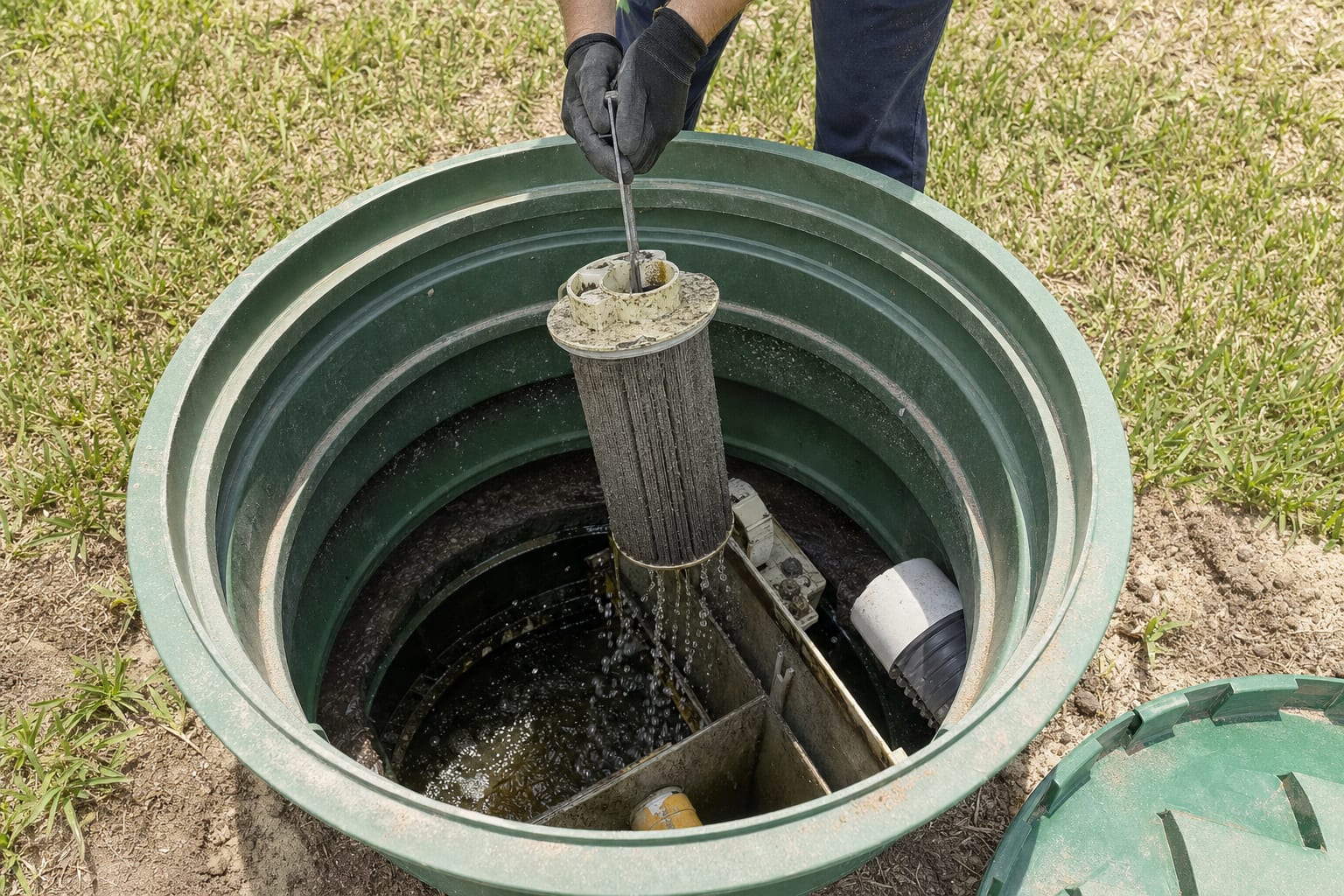
| Effluent filter (clean) | Clogs slow every drain, mimicking a full tank. |
| Effluent filter (replace) | For degraded media or a cracked housing. |
| Lid repair or replacement | A safety item first. Damaged lids should be addressed promptly. |
| Riser installation | Brings buried access up to grade. |
Baffle repair protects the drainfield
A septic tank is a settling chamber. Solids sink as sludge, grease floats as a scum mat, and the liquid between is the only layer meant to leave. The inlet baffle points flow down so it does not stir the sludge; the outlet baffle draws only from that middle layer.
Old concrete baffles spall apart after decades of sewer gas. When an outlet baffle breaks off, scum and solids clog the drainfield soil pores. The soil does not recover. You find out eighteen months later, with a wet spot in the yard and a major drainfield problem.
Cape Coral's shallow water table drives that number. Rule 62-6.006(2), F.A.C. requires 24 inches of separation between the drainfield bottom and the seasonal high water table, and meeting that with sand fill often means an elevated mound system. See drainfield repair.
Cracked septic tank lids come first
Concrete corrodes from below and cracks from above when a truck or a mower crosses it. If yours is cracked, uneven, or showing rebar, cover it with something a child cannot move and call for prompt lid replacement.
Septic riser installation makes future service easier
A riser extends tank access to ground level with a sealed lid on top. If your lid is buried:
- A riser brings the access to grade. The lid stays visible and sealed.
- A buried lid has to be uncovered. Tell us whether you can see it when you call.
- An unmarked tank may need locating. Permit drawings and prior service records help.
Do repairs during a scheduled pump-out. Most of the above needs the tank empty and the lid open. Bundled into a scheduled septic pumping visit, it is one truck, one dig, one bill.
Florida sets no legally required pumping interval for a conventional septic tank. The familiar “every three to five years” comes from the U.S. Environmental Protection Agency and UF/IFAS as guidance, not from a Florida rule.
Repair or replace the tank
Hairline cracks and a weeping seam can usually be patched from inside once the tank is pumped. A wall going or exposed rebar needs a permitted replacement, and that permit and inspection come from the Florida Department of Health in Lee County at 239-690-2100, not from DEP.
If a UEP Notice of Availability is in hand, think hard before spending money on a tank you have 90 days to abandon once you connect. Our septic tank abandonment page walks the two deadlines; areas we serve covers where sewer is not coming.