
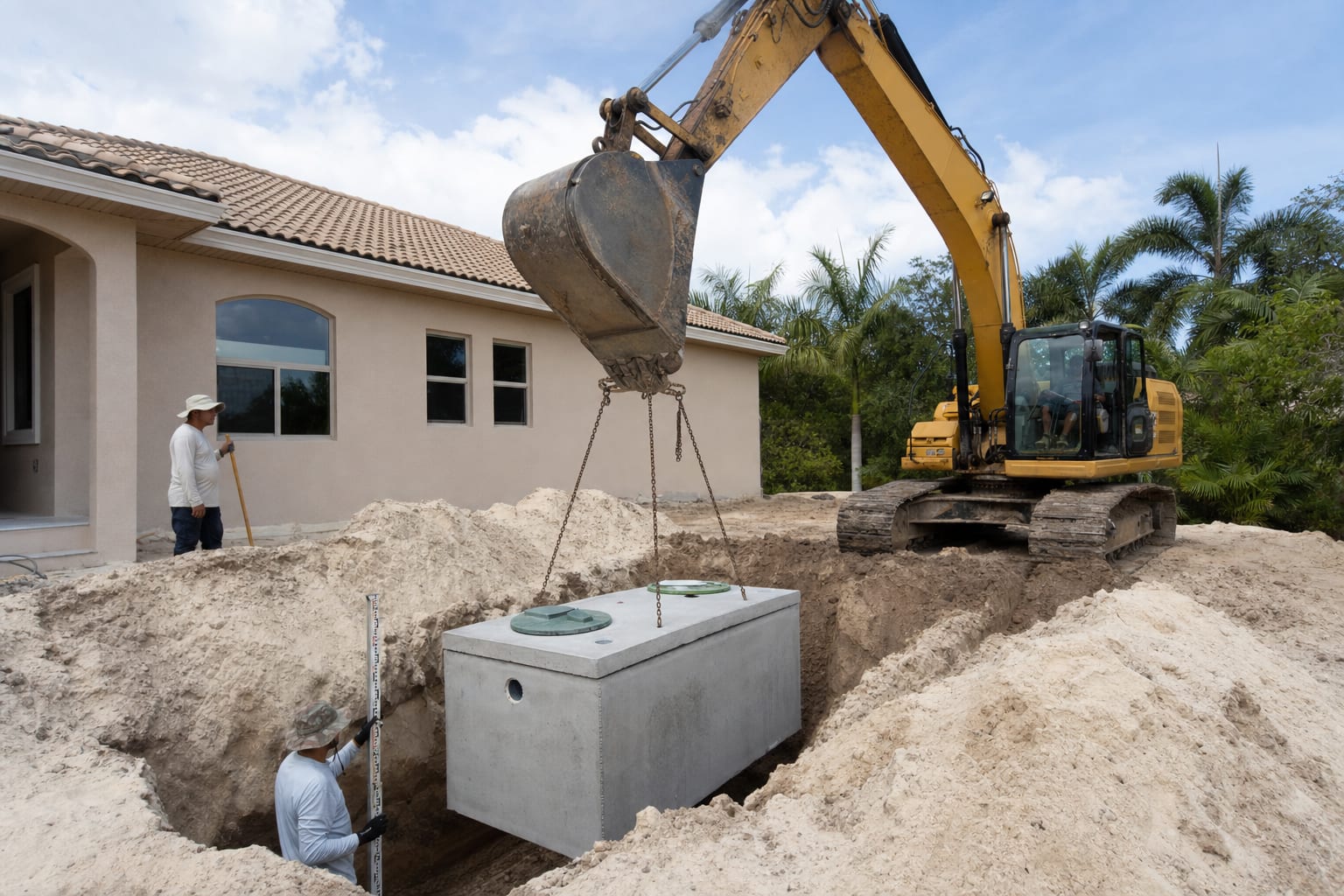
On a Cape Coral lot, the water table decides which septic system installation you are allowed to build. Native soil, required fill, lot access and the permitted design determine the work involved.
Check your UEP phase before you buy a system
Find out where your street sits in the UEP first. Cape Coral is converting from septic to sewer phase by phase, working north from Pine Island Road. If sewer reaches your street soon after you install, you get 180 days from the Notice of Availability to connect and 90 days after that to abandon the tank.
The City's "Find Your Future Utilities Extension Area" lookup answers this for an address, and the UEP hotline is 1-833-227-3837. See septic tank abandonment for how that ends.
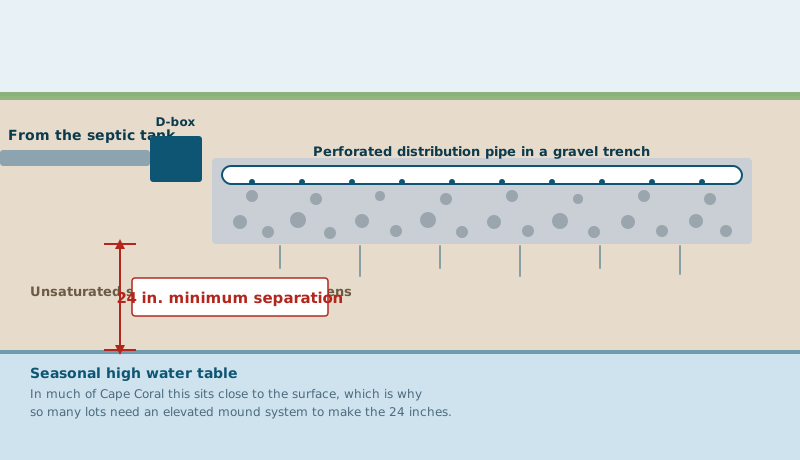
The 24 inches that determine the system type
Florida requires 24 inches of separation between the bottom of the drainfield and the seasonal high water table, under Rule 62-6.006(2), F.A.C. Seasonal is the operative word: the rule is written against the wet season, not the dry February morning someone digs a test hole. Cape Coral gets roughly 57 inches of rain a year, about two-thirds of it June through September, and was platted in 1957 on septic tanks and shallow wells. The ground is flat and sandy and the water is close.
Common septic system types in Cape Coral
| System | When you get one |
|---|---|
| Conventional gravity | The lot holds the 24-inch separation at or near grade. Tank, distribution box, gravity drainfield, no pumps. |
| Mound system | The lot cannot make the separation naturally. Sand fill, a larger footprint, usually a pump. |
| Aerobic treatment unit (ATU) | Where treatment must beat a plain tank: tight lots, difficult setbacks, or a performance-based permit. Adds a blower, power, and maintenance. |
What the DOH-Lee permit involves
- Soil evaluation. A licensed soil scientist logs the profile and establishes the seasonal high water table. The system cannot be designed before this.
- Application. DOH-Lee reviews the site evaluation and proposed design. Confirm current forms and agency requirements at 239-690-2100.
- Review. Generally a few weeks. The permit specifies the system type and size.
- Installation. By a licensed septic system installer, to the permitted design.
- Inspection. DOH-Lee inspects before the system is covered.
The permit comes from the Florida Department of Health in Lee County, 2295 Victoria Ave, Fort Myers, FL 33901. Florida’s onsite sewage program transferred from the Department of Health to the Department of Environmental Protection on July 1, 2021 under the Clean Waterways Act. DEP now sets the statewide rules in Chapter 62-6, F.A.C. (formerly 64E-6), but permitting and inspections are still handled county by county as the transition phases in. In Lee County, which has not transitioned, septic permits and inspections still come from the Florida Department of Health in Lee County rather than DEP.
Where new systems still get built
Almost all of it is north of Pine Island Road, particularly the 33909, 33993, and 33991 ZIPs, on vacant platted lots with no main at the street. As of Lee County’s 2023 Countywide Wastewater Management Plan, about 75% of the county's population was on centralized sewer. The island communities on our areas we serve page have none at all.